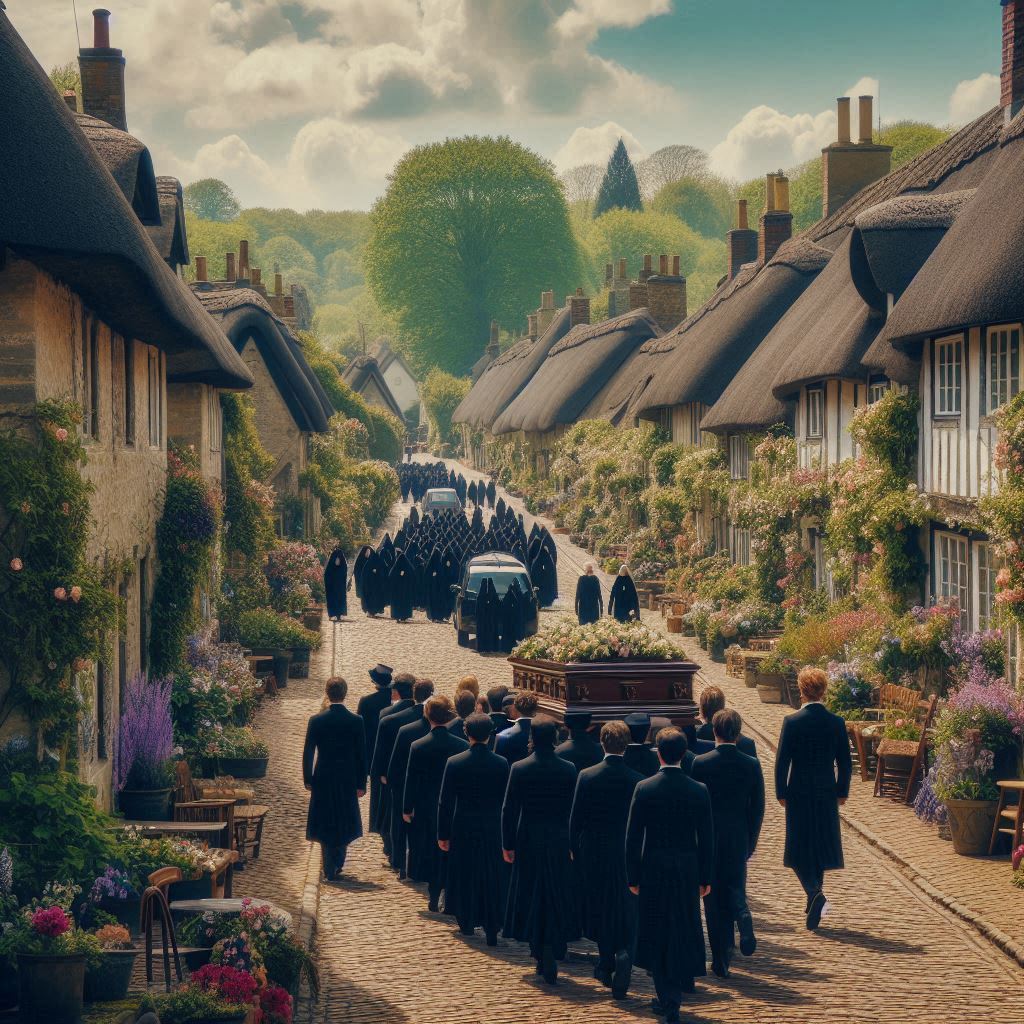
Business tycoon Richard Abernethie knew he wouldn’t live much longer. So he began visiting his relatives one-by-one in an attempt to find a successor. Before he identified a worthy replacement, he died, leaving his family to share his fortune equally. What could possibly go wrong?
The Story In After The Funeral
Richard Abernethie’s siblings, in-laws and nieces and nephews gather in the ancestral home after his funeral and learn that Abernethie has left them each an equal portion of his sizable estate. This, as one might imagine, delights them all, until his sister, Cora, announces rather matter-of-factly, that her dear brother was, in fact, murdered.
Cora’s announcement is met with a healthy dose of skepticism–after all, Cora has a history of blurting out inconvenient “truths” at inopportune moments–but the family’s skepticism is dented when Cora is found bludgeoned to death the next day.
Did Cora’s pronouncement about her brother get her killed? Was she murdered by a relative dissatisfied with their piece of the inheritance pie? Or is something more sinister in play? Poirot certainly has his work cut out for him.
My Thoughts On After The Funeral
I thought After The Funeral was one of Christie’s best mysteries right up to the moment I finished it. Then, doubts about the “how” crept in, marring (though only slightly) my reading experience. There isn’t much I can say without spoiling the story, but let’s give it a try:
Cora’s murderer plays a number of tricks on the Abernethie family–including one I’ll call the BIG One–and they all work, even if the Big One does require a certain suspension of belief. But then the murderer has to … how do I put this … play the Big One sort of in reverse and it just wasn’t completely believable. Still, it’s a story worth reading. (And at least she didn’t pair a naive young woman with an attempted murderer or experienced criminal this time.)
One of the most common criticisms bandied about the Christie readership is that her characters are “cardboard”. But is a “cardboard” character really all that bad? I maintain that it isn’t and I suspect it’s part of Christie’s appeal. After all, we all know a scatterbrained, impulsive Cora, who has no filter and no sense of appropriateness. We all know a poor, put-upon Maude, longsuffering in a difficult family situation. And a gentle Helen, a philandering Michael, and an ambitious Susan. By resisting the urge to describe these characters in all their minutia, Christie allows us to build these characters into fictional versions of people we know and love (or fear, or hate) in real life.
My audiobook of After The Funeral was narrated by Hugh Fraser; my text was an original 1953 edition.
###






 Lisa Barger
Leave a comment